BMSB Update: Stink Bug Feeding Continues on Late Variety Apple. Assess Fruit Injury.
Overview:
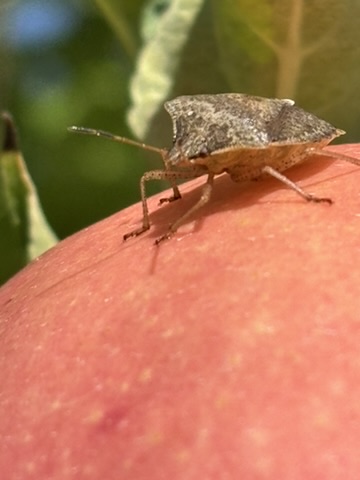
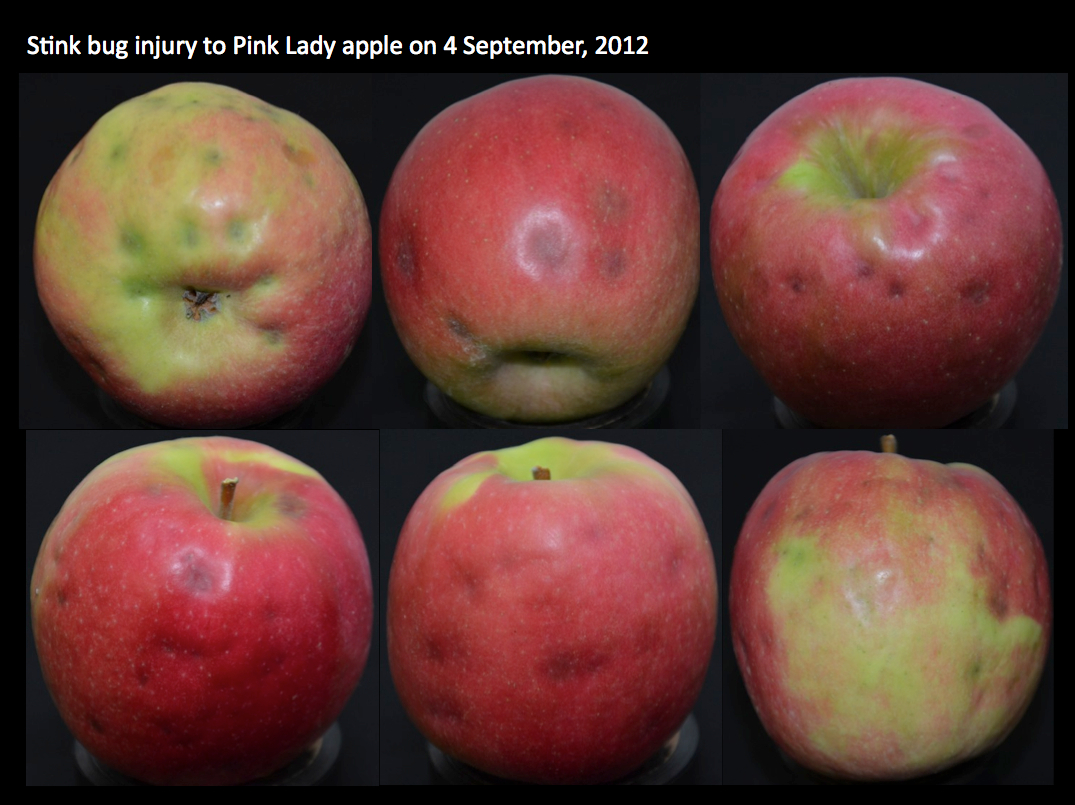
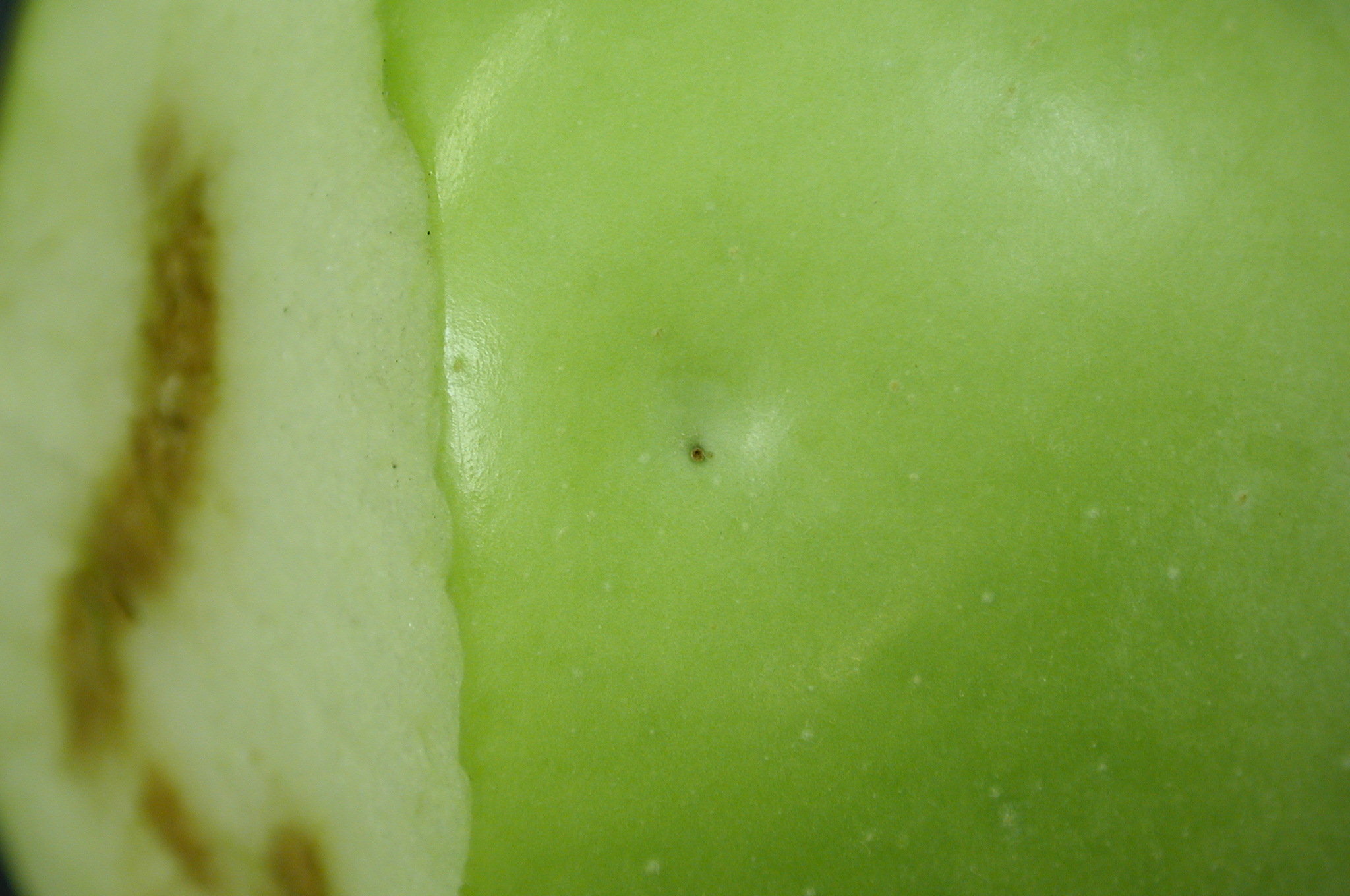
BMSB feeding on Pink Lady Sept.8 Lower Hudson Valley, NY
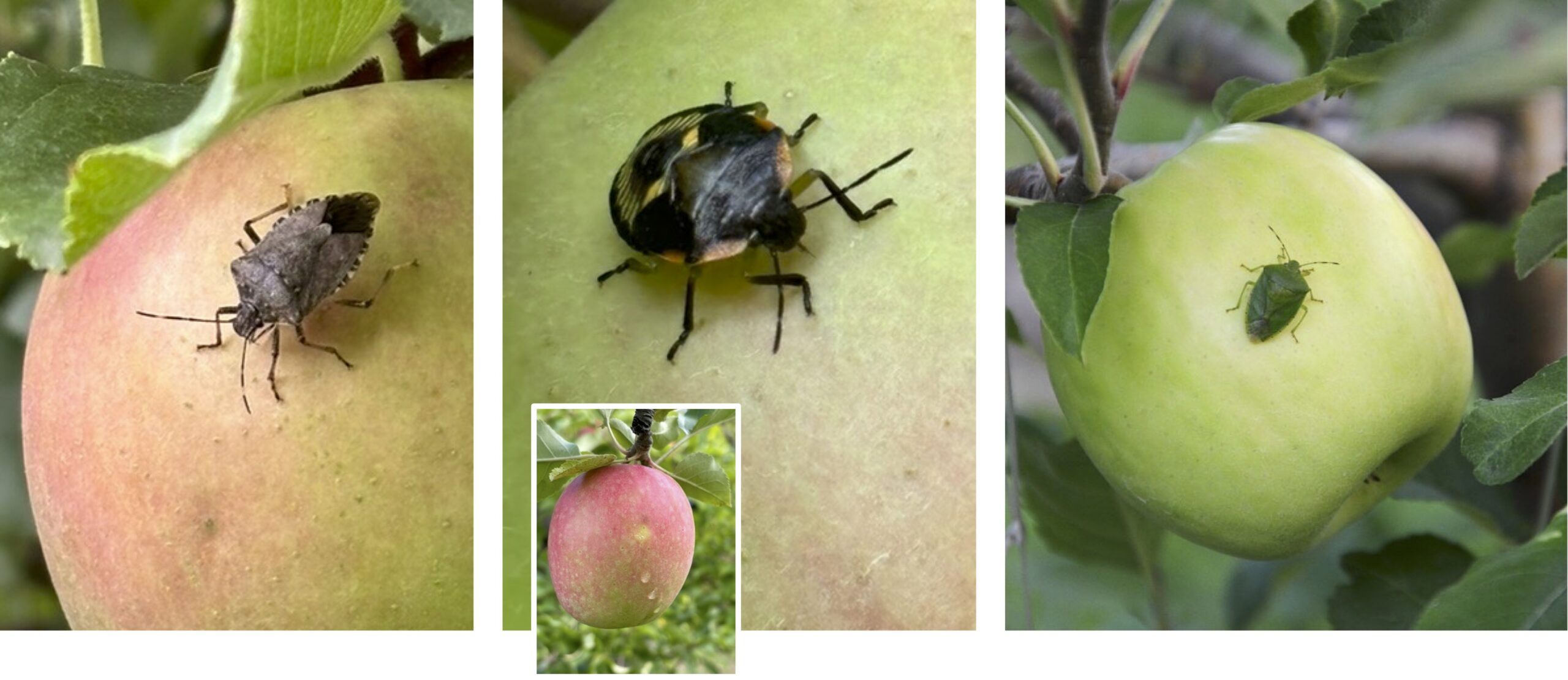
Trapping efforts throughout the Hudson Valley have documented the presence of brown marmorated, green and brown stink bug since Mid-June. All three species have been found feeding on fruit this season.
Their presence along border trees in early-mid August was observed causing feeding damage in Honeycrisp and other red colored varieties. BMSB began movement into orchards in earnest as nymph populations transitioned to adults to begin intensively feed, stocking up on sugars from sap needed to successfully overwinter.
In orchards throughout the Hudson Valley we’ve captured ‘Threshold’ numbers of adult BMSB in Tedders Traps pheromone trap captures in mid-late August (@ 10/trap/week). Threshold for the use of a baited panel trap should be 2-3/trap. Populations above the adult threshold should then be managed prior to trap reset with an effective insecticide. Be aware of the need for short PHI materials ( Venerate XC (0d PHI), Leverage 360 (7d PHI) ,Baythroid XL (7d PHI)) Heavy rains exceeding 1″ require re-application at very short intervals.
Indications of stink bug presence can be observed in the presence of live SB in fruit clusters and in harvested bins with examples of fruit injury of varieties remaining on the trees as is shown in the photos below.
Control measures should be taken if this type of fruit injury is being observed. Very few insecticides are very effective against this insect complex with regards to residual efficacy. Those listed below are labeled for use against BMSB in NY and represent the best of university and USDA bioassay tested insecticides that will help to reduce the injury and increase mortality of the population. Consider using a non-ionic surfactant to increase penetration of the active ingredients. However, a tight schedule of no less than 7 days should be made if new fruit damage and stink bug adults continue.
Fruit Injury: Over the past 8 weeks we have been seeing a steady increase in populations of the invasive brown marmorated stink bug (BMSB) in our pheromone baited Tedders traps placed along the woodland orchard edges. It’s no surprise that we also seeing an increase in feeding injury BMSB on red and yellow colored varieties, especially along the orchard perimeter.
Its very important to note that stink bug injury does not express itself immediately on the fruit. Apple recently fed upon by the SB complex will likely be harvested and stored without blemish, only to find the same fruit with very high levels of fruit damage after its removal from cold storage. Efforts should be made to manage this insect complex prior to harvest.
Management for this insect pest should continue until the last fruit is off the tree. Use of a 10 BMSB per baited BMSB Tedders trap threshold, followed by scouting along the orchard perimeter and use of a single adult stink bug as a threshold within 100′ of perimeter row, then followed by border row, alternate row and whole orchard applications if these thresholds are met should be strongly considered as movement of native and BMSB populations begin to migrate to and from orchards to feed, preparing for overwintering.
Much confusion about injury can arise at harvest given the four types of late season injury that can occur to fruit. These are:
* Stink bug injury for three different species (Green, Brown and Brown Marmarated stink bugs)
A discolored depression.
Always a ‘sting’ site in the center of the depression.
Upon slicing, corking up to the skin surface.
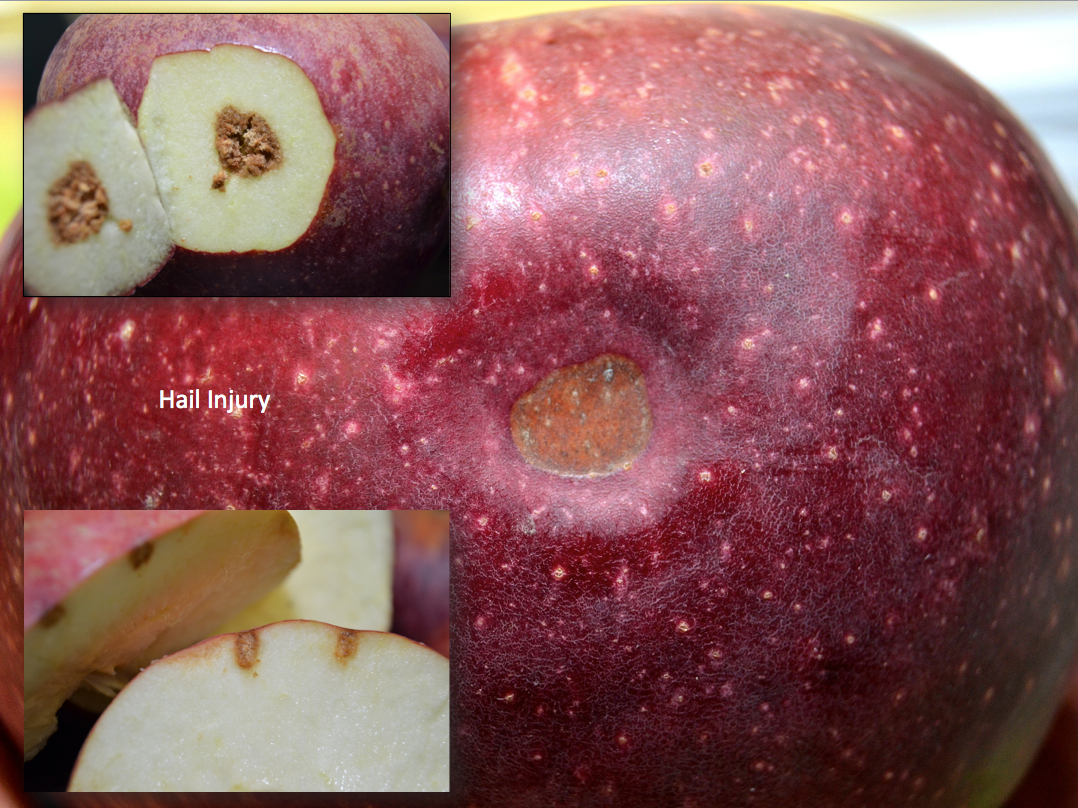
* Hail injury during the season
A discolored depression.
Never a ‘sting’ site in the center of the depression.
Upon slicing, corking up to the skin surface.
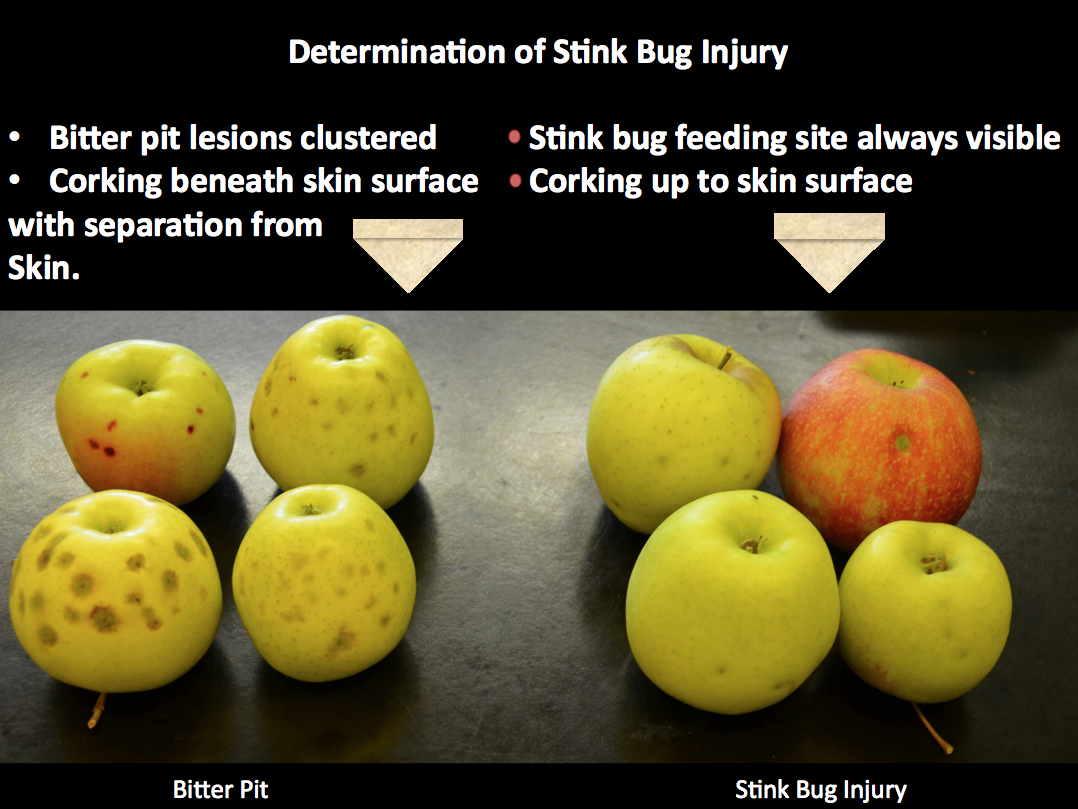
* Bitter pit from calcium deficiency requiring applications throughout the season
A discolored depression.
Never a ‘sting’ site in the center of the depression.
Upon slicing, corking separated from the skin surface.
* Apple maggot from oviposition or egg laying site or ‘sting’ in fruit surface
Sometimes a depression. Most often only slight discoloration.
Always a ‘sting’ site in the center of the depression.
Upon slicing, no corking BUT soft, oxidized fruit flesh, often with tunneling well into the fruit.
Sting larger then SB feeding site, and always easy to see.
Cutting directly beneath the sting will give rise to juice seeping up from the egg laying sting.
See images related to injury below.
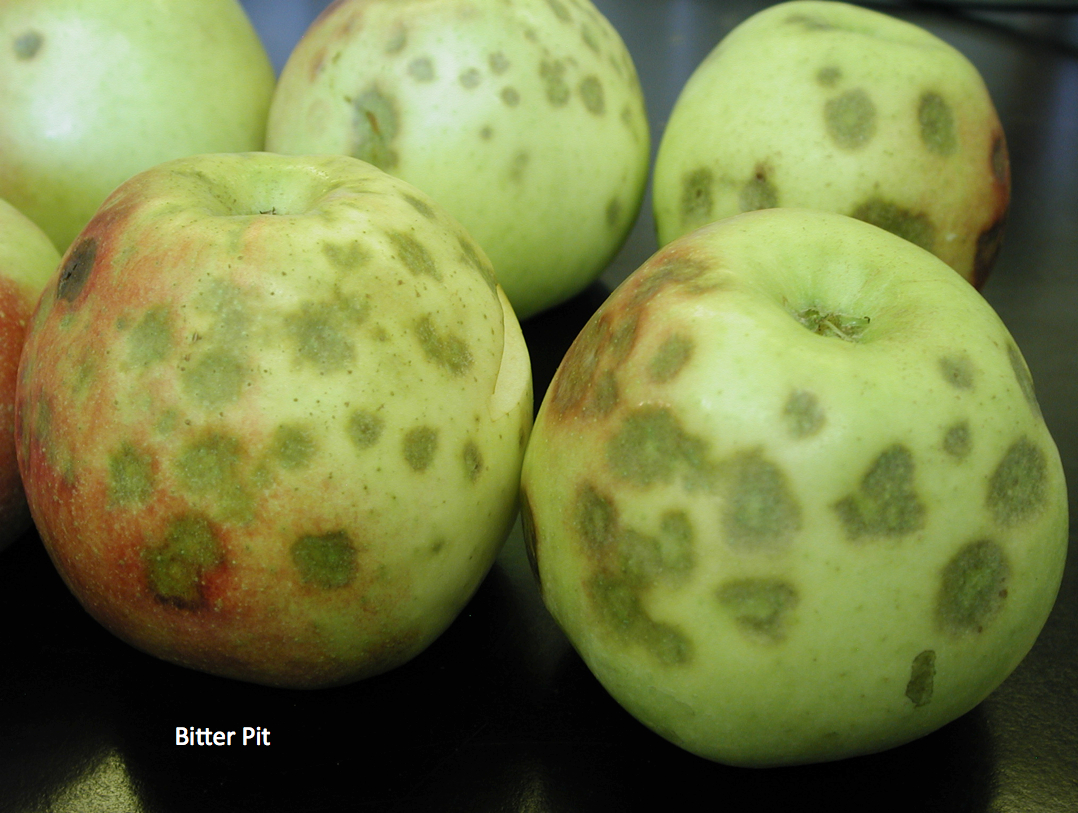
Bitter Pit on Jonagold, August 2012
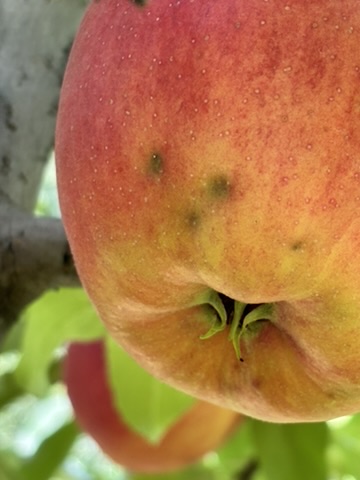
Severe BMSB feeding injury to Pink Lady
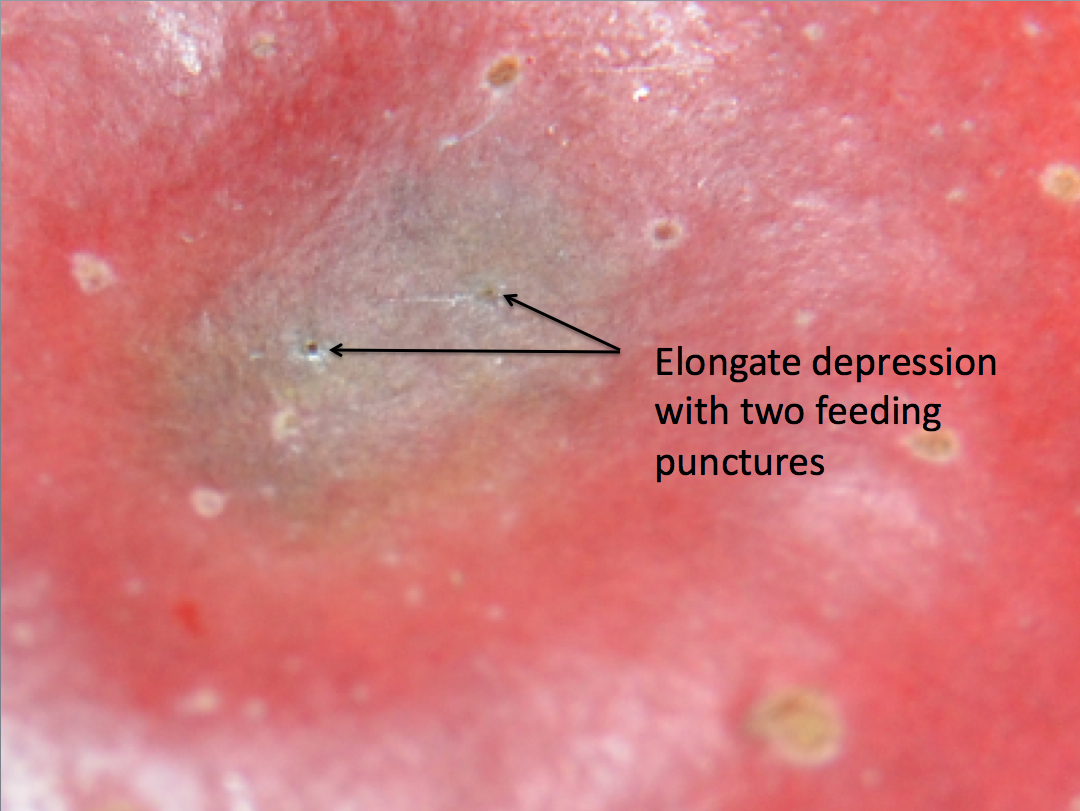
Multiple stink bug feeding punctures with
discolored depression and corking to skin surface.Hail injured Stayman fruit with discolored depression,shallow corking to skin surface; No feeding punctureComparison of bitter pit and stink bug injuryApple Maggot Sting. Oxidation, often trails through fruit.
No trails or live larva when neonicotinoids are used as they are locally systemic, killing the egg and developing larva
Apple Maggot on red sphere trap
@
Cookie Consent
We use cookies to improve your experience on our site. By using our site, you consent to cookies.
This website uses cookies
Websites store cookies to enhance functionality and personalise your experience. You can manage your preferences, but blocking some cookies may impact site performance and services.
Essential cookies enable basic functions and are necessary for the proper function of the website.
Name
Description
Duration
Cookie Preferences
This cookie is used to store the user's cookie consent preferences.
30 days
These cookies are needed for adding comments on this website.
Name
Description
Duration
comment_author
Used to track the user across multiple sessions.
Session
comment_author_email
Used to track the user across multiple sessions.
Session
comment_author_url
Used to track the user across multiple sessions.
Session
Google Tag Manager simplifies the management of marketing tags on your website without code changes.
Name
Description
Duration
cookiePreferences
Registers cookie preferences of a user
2 years
td
Registers statistical data on users' behaviour on the website. Used for internal analytics by the website operator.
session
These cookies are used for managing login functionality on this website.
Name
Description
Duration
wordpress_logged_in
Used to store logged-in users.
Persistent
wordpress_sec
Used to track the user across multiple sessions.
15 days
wordpress_test_cookie
Used to determine if cookies are enabled.
Session
Statistics cookies collect information anonymously. This information helps us understand how visitors use our website.
Google Analytics is a powerful tool that tracks and analyzes website traffic for informed marketing decisions.
Contains information related to marketing campaigns of the user. These are shared with Google AdWords / Google Ads when the Google Ads and Google Analytics accounts are linked together.
90 days
__utma
ID used to identify users and sessions
2 years after last activity
__utmt
Used to monitor number of Google Analytics server requests
10 minutes
__utmb
Used to distinguish new sessions and visits. This cookie is set when the GA.js javascript library is loaded and there is no existing __utmb cookie. The cookie is updated every time data is sent to the Google Analytics server.
30 minutes after last activity
__utmc
Used only with old Urchin versions of Google Analytics and not with GA.js. Was used to distinguish between new sessions and visits at the end of a session.
End of session (browser)
__utmz
Contains information about the traffic source or campaign that directed user to the website. The cookie is set when the GA.js javascript is loaded and updated when data is sent to the Google Anaytics server
6 months after last activity
__utmv
Contains custom information set by the web developer via the _setCustomVar method in Google Analytics. This cookie is updated every time new data is sent to the Google Analytics server.
2 years after last activity
__utmx
Used to determine whether a user is included in an A / B or Multivariate test.
18 months
_ga
ID used to identify users
2 years
_gali
Used by Google Analytics to determine which links on a page are being clicked
30 seconds
_ga_
ID used to identify users
2 years
_gid
ID used to identify users for 24 hours after last activity
24 hours
_gat
Used to monitor number of Google Analytics server requests when using Google Tag Manager